
Feline Hypertrophic Cardiomyopathy (HCM) in Maine Coon Cats
November 4, 2023
What is Feline Hypertrophic Cardiomyopathy (FHCM)?
Feline hypertrophic cardiomyopathy, or FHCM, is an inherited condition that causes heart failure and sudden death in cats, with the Ragdoll and Maine Coon breeds being disproportionately affected. Genetic researchers approximate that the primary known genetic mutation that causes HCM affects 25 percent of the Maine Coon breed. Unfortunately, despite the best efforts of ethical Maine Coon breeders to breed away from this known genetic mutation, many backyard breeders and kitten mills fail to adequately test their breeding cats and continue to spread feline HCM to new generations of Maine Coon kittens through affected family lines.
Is my Maine Coon kitten at risk of developing HCM?
The first indicator that currently healthy Maine Coon kittens may develop feline HCM in the future is a history of HCM in either parent’s bloodline. The second most important risk factor is a positive finding of the known genetic mutation linked to the disease – the HCM1 genetic mutation – on a DNA test.
There are several commercially available, relatively inexpensive DNA tests you can use at home to find out if your Maine Coon inherited the HCM1 mutation. Some well-known tests include Catscan by Neogen Labs, Optimal Selection by Wisdom Panel, and Basepaws, among others. You collect a sample (usually a cheek swab) at home using the kit the lab provides you, mail it off, and in two to three weeks, you’ll get the results.
Based on the test results, you’ll discover if your Maine Coon cat or kitten has inherited one (heterozygous) or two (homozygous) copies of the HCM1 mutation or if they are negative entirely (which is the best possible outcome).
- If your cat did not inherit the mutation from either parent, their result will be N/N.
- A cat with one copy of the genetic mutation will show an HCM/N result. Maine Coon cats that carry one copy of the HCM1 genetic mutation in their DNA are ~1.8X as likely to develop HCM than a Maine Coon cat without the mutation. If used in a breeding program, the heterozygous Maine Coon cat will pass the genetic mutation along to approximately half of their Maine Coon kittens.
- A cat that inherited two copies will have a result that reads HCM/HCM. Maine Coon cats that carry two mutated copies of the HCM1 mutation (one from each parent) are at 18X the risk of developing HCM. Essentially, it is safe to assume that a Maine Coon kitten that is homozygous for the genetic mutation is more likely than not to develop HCM. If bred, they will pass this mutation along to 100 percent of their offspring. Maine Coon cats with two copies of the HCM1 mutation should be screened for HCM regularly throughout their life and should never be used in a breeding program.
This is an excerpt from Oscar’s DNA testing. We use Catscan by Neogen Labs for all our breeding cats. Here you can see that Oscar is Normal (Clear) of the genetic mutation associated with HCM in the Maine Coon cat.

Do all Maine Coon cats that test positive for the HCM1 mutation develop HCM?
No, thank goodness. HCM is a disease with “incomplete penetrance” and “variable expression.” In plain English, this means that cats with the genetic mutation may or may not go on to develop HCM, and, if they do, the degree to which they have symptoms will vary widely from one cat to another, even in related families. Maine Coon cats with two copies of the HCM1 mutation are 18x more likely to develop HCM than cats with no genetic mutation, and the disease is more likely to be severe in these cats, but there can be a wide range of symptoms even in those cats that are affected.
Can a Maine Coon that tests negative for the HCM1 mutation still develop HCM?
Yes, unfortunately. Maine Coon kittens and cats that are negative for the known HCM1 mutation sometimes still develop HCM. In fact, in one study, seven out of 21 Maine Coon cats diagnosed with feline HCM did not carry the known genetic mutation. How can this be? The unfortunate reality is that some DNA-negative Maine Coons go on to develop HCM because there is at least one, if not more, genetic causes that we have yet to identify, which are not included in DNA testing.
For example, in recent years, a College of Medicine researcher at the University of Cincinnati identified a different genetic heart variant that was causing trouble for a Maine Coon cat named Freddie after being approached by Freddie’s puzzled owner. With a blood sample from Freddie, as well as his parent cats, the researchers used genetic sequencing to look for other genetic variants that might be making him sick. What they found is that both of Freddie’s parents had one mutated copy of troponin-T (TNNT2), which is associated with sudden cardiac death in humans. Their findings appear in the scholarly journal Frontiers in Physiology.
Hopefully, one day soon, we will know more about this and any other variants that may cause HCM in our beloved Maine Coon cats, as well as how to test for them. Because HCM in humans and feline HCM are so similar, researchers continue to study HCM in Maine Coon cats, and we hope this will lead to additional breakthroughs.
How can I safely purchase a Maine Coon kitten that is unlikely to develop HCM?
As a pet buyer, you can do your part to avoid heartache and help shut down backyard breeding programs by researching carefully and choosing a breeder who takes health testing very seriously. Choose an ethical breeder that combines the powerful combination of DNA testing with regular screening by a veterinary cardiologist using echocardiography. This is the gold standard for health testing for HCM.
A best practice is for Maine Coon breeders to only use breeding cats that are DNA negative and to also have every potential breeding cat undergo an echocardiogram when they’re between 10-12 months old, before their first breeding, and routinely after that. For males, annual echocardiograms are warranted, given how many kittens one male can father each year. For females, testing at age one and again at ages three and five makes sense.
What does feline HCM do to the Maine Coon cat’s heart?
The heart is a four-chambered pump divided into left and right sides. Each side is divided into two chambers: a thin-walled chamber at the top where blood enters the heart (the atrium) and a larger, lower chamber (the ventricle) where blood flows from the atrium. The left atrium in the heart is responsible for receiving oxygenated blood from the lungs. In contrast, the left ventricle is responsible for pumping this oxygen-rich blood out to all the parts of the body that need it.
When a Maine Coon cat is afflicted with HCM, their left ventricle becomes abnormally thickened and stiff. This diseased chamber can’t relax enough to allow all the rich oxygenated blood in the left atrium to flow normally between each heart contraction. Because the ventricle doesn’t fill completely, it can’t pump enough blood to meet the body’s oxygen demands.
Imagine exhaling a deep breath to fill a latex balloon. The ease with which your air flows into the balloon represents how blood flows from the atrium into the left ventricle in a healthy heart. Now, imagine trying to exhale a deep breath into a hot water bottle. The thick, stiff water bottle represents the left ventricle of the Maine Coon with feline HCM. Blood obviously flows into the rigid chamber much slower. Because of this, the left ventricle cannot fill entirely with oxygenated blood before the heart pumps again.
Unfortunately, because the left ventricle cannot accept all the blood the atrium is trying to push forward, too much blood pools in the left atrium. Over time, the left atrium stretches thin to accommodate the backflow of blood. As it does, it begins to weaken like a balloon that has been repeatedly overinflated. The weaker the atrium becomes, the more difficulty it has pumping blood into the stiff left ventricle.
A vicious cycle begins. Unable to pump out enough blood to satisfy the body’s oxygen needs, the heart automatically pumps faster. To maintain this rapid rhythm, the heart itself needs more oxygen-rich blood, which, of course, it cannot get. The faster the sick heart with HCM beats, the less efficient the heart becomes. The constant lack of oxygen causes further damage to the heart cells and the walls of the left ventricle.
Now, things spiral out of control. The heart’s pumping action is severely compromised. The Maine Coon cat ends up suffering from congestive heart failure, a condition in which fluid backs up and accumulates in the lungs, causing severe shortness of breath and eventually leading to the cat’s passing.
Sudden death is a less common but devastating consequence of feline HCM, occurring without warning in kittens as young as five months old. In the most horrifying of scenarios, a seemingly healthy Maine Coon may appear fine one minute, then pass away just moments later. Most often, this is due to the onset of a severe cardiac arrhythmia (electrical problem) or thromboembolism, a condition that occurs when a blood clot develops in the heart and travels through the bloodstream to severely damage another part of the cat’s body, such as their legs, lungs, or brain.
How old are Maine Coon cats when they develop HCM?
When and how feline HCM shows up in Maine coon cats varies based on the severity of the disease in the individual cat. The condition is unlikely to be detected while a young kitten is with the breeder. Instead, HCM commonly becomes evident during the latter stages of kittenhood or Maine Coon adolescence, when the Maine Coon kitten is between 8 and 36 months old. Once detected, HCM progressively worsens during young adulthood until it reaches critical mass. Most Maine Coons that are very sick with HCM reach the peak of the disease between 18 months and three years of age. However, there are cases where the symptoms of HCM do not appear until much later in the Maine Coon cat’s life, with a higher percentage of females than males getting a later-in-life diagnosis.
What are the symptoms of HCM in a Maine Coon kitten or cat?
Because of its variable expression, many cats with HCM will not show symptoms. Some may live a normal life, while others will become acutely ill or die suddenly, without warning. Signs and symptoms of concern that warrant a veterinary visit and cardiology consult include:
· An unexplained cough
· Unusual weakness or fatigue given the cat’s age
· A loss of appetite
· Difficulty breathing or shortness of breath
· Abnormal heart sounds (muffled, galloping rhythm, murmurs)
· Inability to tolerate exercise or vigorous play
· Sudden hind-limb paralysis or blindness
· Collapse
How is HCM diagnosed?
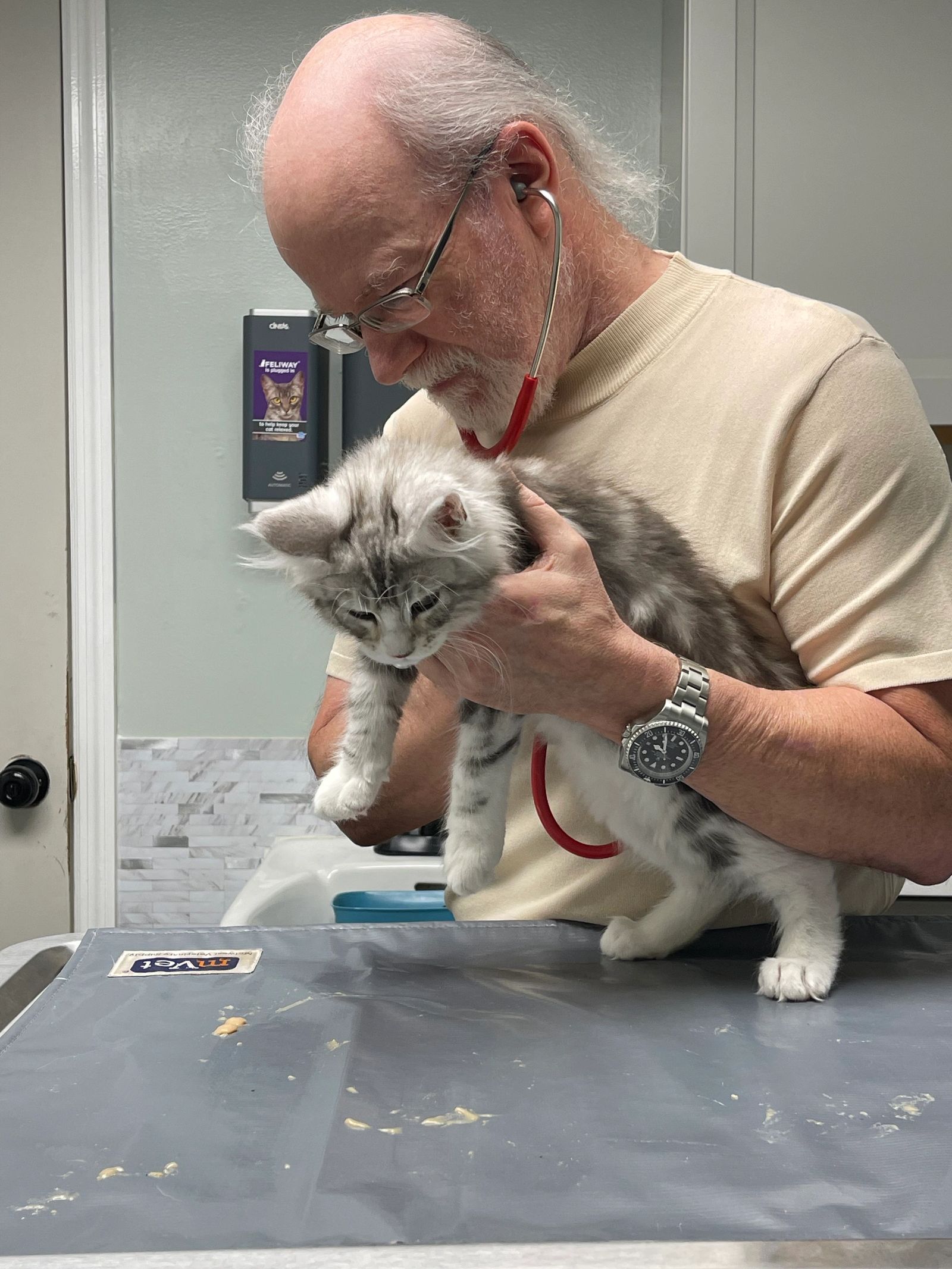
As many cats with HCM are asymptomatic, annual check-ups with your veterinarian are so important. Any Maine Coon adult cat found to have a heart murmur or tachycardia on physical exam warrants a closer look by a cardiologist. If you or your veterinarian suspect your Maine Coon may have HCM, you should make an appointment with a board-certified veterinary cardiologist. In addition to reviewing DNA test results and lab work, they will physically examine your Maine Coon, listening for a heart murmur that may be present due to abnormal blood flow across the heart’s valves. Your cat’s heart rate will also be monitored because cats with HCM often have tachycardia (increased heart rate). After the physical exam, the cardiologist will perform an echocardiogram (a heart ultrasound) to measure the thickness of the heart muscle, the size of the heart’s chambers, and the flow of blood through the valves using Doppler. An echo is the gold standard test for making a definitive HCM diagnosis.
Can HCM be treated or cured?
Maine Coon cats diagnosed with HCM can be treated; however, the condition is complex for even the experts to manage. A veterinary cardiologist must be involved, and the cost of care is significant. Using medications, the goals of treatment are to control the Maine Coon cat’s heart rate, alleviate fluid in the lungs (congestive heart failure), and prevent the formation of often fatal blood clots.
Medications that are often used include atenolol, which helps the heart contract and may help lower the risk of sudden death, and ACE inhibitors. For cats with HCM-related heart failure, the cardiologist may prescribe furosemide to help remove extra fluid from the lungs. Finally, blood thinning medications like Plavix may be used to try and prevent blood clots that can form in the heart and travel elsewhere in the body with devastating consequences.
The visits to the veterinarian and cardiologist, the testing, and the medication therapy are a significant burden. The cat may not feel well. For the loving owner, there is a constant worry. Sadly, many Maine Coons with two copies of the HCM1 genetic mutation will die from HCM by the time they are four years old, even with the very best medical care.
Disclaimer:
The information provided by Maine Street Coons and its owner, Kyra Hagan, is for general educational purposes only and reflects the breeder’s personal experience. It is not professional veterinary advice, diagnosis, or treatment. Maine Street Coons is a private cattery, and Kyra Hagan is not a licensed veterinarian.
All health decisions should be made with a licensed veterinarian who has examined your cat. Every Maine Coon is unique, and health outcomes can vary due to genetics, environment, and other factors.
Maine Street Coons makes no guarantees about the accuracy or applicability of the information provided. Always consult your veterinarian for personalized guidance. In case of a medical emergency, contact your vet or an emergency animal hospital immediately.
Sources:
https://www.ncbi.nlm.nih.gov/pmc/articles/PMC3044103/
https://phys.org/news/2021-03-maine-coon-cat-owners-feline.html